Disc-Renew-9x
DISC RENEW 9x Explained
Offering anti-inflammatory benefit – even potential prevention & regeneration of degenerated discs.
The loss of Chondroitin Sulfate (CS) is detrimental. CS is the Glycosaminoglycan (GAG) constituent of the human intervertebral disc that stimulates synthesis of the disc. CS is GAG, the chemical of the disc that imbibes water to 9 times its own volume. Poor nutritional supply has a longterm effect on disc degeneration with low CS and water content in the human intervertebral disc. (53) Disc nutrient concentrations may fall to levels that are inadequate to maintain cell activity or viability which results in cell death and disc degeneration, a major cause of biologic changes in disc cells. (54, 55) CS being a natural GAG is found in the cartilage and extracellular matrix. (56) GAG loss plays a central role in disc degeneration. (57) Lower GAG accompanies disc degeneration and disc disorders (disc protrusion and extrusion). (58) Low proteoglycan (CS/GAG) concentrations in all the discs of a spine precede disc degeneration. (59) Cell number and GAG formation dramatically decrease with aging. (60) Yet human disc degeneration occurs as early as adolescence, so early supplementation is indicated to protect disc cells. Adding nutrient and biomechanical factors help retard or reverse disc degeneration and repair or regenerate degenerated discs. (55) Research shares the benefits of CS-as well as GS-for the body as anti-inflammatory, long-lasting, cell and nerve health protective, and pain reducing and function improving.
Anti-inflammatory:
• One article expresses concern about glucosamine supplementation due to its findings that showed slowed disc matrix repair. (61) Yet another article points out that glucosamine prevents cartilage degradation and may reduce inflammation to help joint health and function and prevent or delay onset of osteoarthritis. (62)
• Novel omega-3 polyunsaturated fatty acids extracts from the green-lipped mussel (Perna canaliculus) inhibit leukotriene and cyclooxygenase (COX) activity, both of which are involved in the inflammatory process. Chronic inflammation has been linked to a range of conditions linked to heart disease, osteoporosis, cognitive decline and Alzheimer’s, and type-2 diabetes. (48, 63)
• The New Zealand green-lipped mussel extract -a rich source of iron, betaine, and GAGs (including CS) – enjoys a reputation as a natural
product with anti-inflammatory properties -an effect that has been attributed to a body of science due to its lipid factions. (64)
• CS inhibited cytokines IL-6 and PGE (2). (65)
Long Lasting Effect:
• CS seems to have slow but gradually increasing clinical activity in osteoarthritis and the benefits last for a long period after the end of treatment. (66, 67)
• Positive response lasts 3 months after taking CS. (68)
• The benefits of intra-articular hyaluronic acid (HA) injections are longer-lasting compared with intra-articular corticosteroid injections.
Cell & Nerve Health:
• Disc nutrient concentrations of CS could fall to levels inadequate to maintain cellular activity or viability, resulting in cell death and disc degeneration. (54)
• Upon nerve injury, the body reacts by starting a system of nerve repair involving neurites. CS proteoglycans
(CS-PGs) are present in the nerve extracellular material and guide positive axonal growth to direct nerve regeneration. (70) In the central nervous system, they regulate cell adhesion and migration, neurite formation, polarization of neurons, synaptic plasticity, survival of neurons, etc. (71)
Pain Reducing & Function Improving:
• CS offers pain relieving benefits. (72) 71% of low back pain patients get pain relief, increased spine motion, and increased exercise tolerance. (73)
• CS is effective against arthrosis for pain reduction and joint function improvement, is well tolerated and allows for diminishing the dose of drugs. (68)
• 73% of patients showed low back pain relief and improved spinal function. CS is included in treatment of low back pain as a chondroprotective drug. (74)
• The combination of NSAIDs with structure-modifying agents (CS/”structum”) could achieve rapid rehabilitation of patients with locomotor activity and improve quality of life in general for non-specific back pain. (75)
In order to repair or regenerate the degenerated disc, nutrient and biomechanical factors need to be addressed. (42) Degeneration may start as early as adolescence. The earlier degeneration sets in, the more it affects the mechanical function of the disc.
Just moderate decreases in the disc’s nucleus glycosaminoglycan content may do this. (40) Further, aging sees a shift in the chondroitin sulfate content of the disc (SO) as well as in glycosaminoglycan formation (41) leading to degeneration.
Chondroitin sulfate (CS) and glucosamine sulfate (GS) [components of Glycosaminoglycan (GAG)] are naturally occurring substances that are essential for cartilage maintenance as well as necessary for cartilage regeneration. Together, they help chondrocytes within cartilage form new cartilage. The amount of proteoglycans formed depends upon the amount of glucosamine present. The more glucosamine available, the more proteoglycans can be made. (11)
The matrix of the intervertebral disc is mainly glycosaminoglycan (GAG) which attracts and holds large quantities of water. GAG contains CS and GS. These sulfates are chondroprotective agents that inhibit enzyme breakdown of cartilage and hamper the production of inflammatory agents. CS reaches synovial fluid and joint cartilage when taken orally between 2 and 5 hours later. Orally taken GS boosts GAG synthesis in degenerated cells as about 90% of it is absorbed and merged into articular cartilage. So taking GS and CS together is more effective than taken alone which further allows larger reductions in NSAID use for osteoarthritis patients. (SO)
One of the most popular and effective substances used by doctors in Europe for arthritis is chondroitin sulfate A (CSA). CSA is naturally found in bones, cartilage, tendons, ligaments, vertebral discs as well as in many plants. (17) In one study, 77% of those taking CSA reported reduced inflammation whereas those receiving NSAIDs only reported 42% reduced inflammation. {17) Chondroitin sulfate repairs degraded bones, increases the absorption and replacement of calcium and diminishes the disease, and begins rebuilding the damaged area with none of the health risks of NSAIDs. {17)
To get the most benefit of chondroitin sulfate, you need the most beneficial source which is perna canaliculus. From the green lipped mussel (pictured to the right: a shellfish so those allergic to shellfish should be cautious), pure chondroitin sulfate offers antiinflammatory properties due to its unique omega-3 polyunsaturated fatty acid extracts. These are found to inhibit leukotriene and cyclooxygenase (COX) activity, both of which are involved in the inflammatory process. (48) It is reportedly the “single most effective” item for relief of joint pain and inflammation as occurs with disc herniations, osteoarthritis, and rheumatoid arthritis. (17):
- may decrease (or eliminate) pain of rheumatoid and osteoarthritis
- may help restore mobility to degenerated joints/cartilage
- may decrease joint distortion from degeneration of joint tissue
Long term use of chondroitin sulfate combines structure modifying and symptom modifying effects on osteoarthritis progression prevention and suggests it could be a disease-modifying agent in patients with knee arthritis. (49)
WHAT IS DISC DEGENERATION? WHAT MAY HELP?
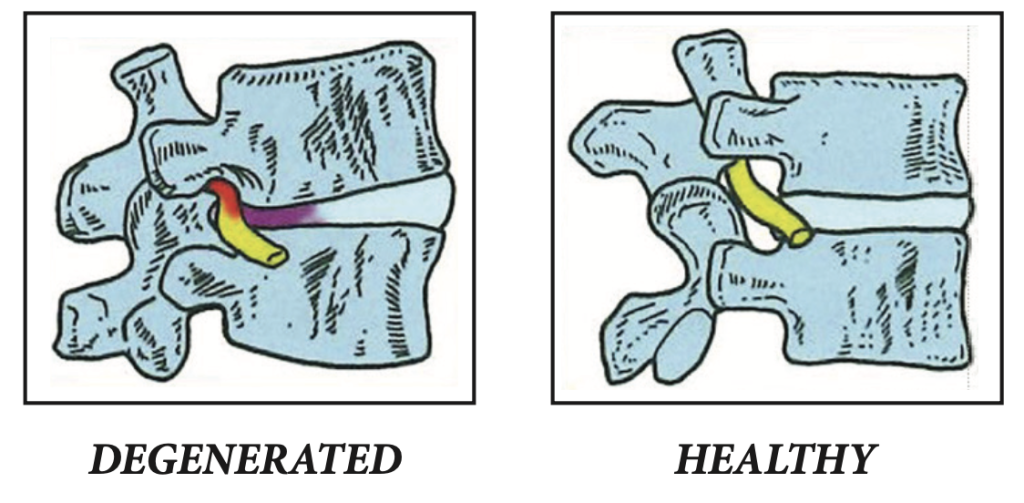
Disc degeneration is a loss of chondroitin sulfate from the disc which results in a loss of water and shrinkage of the disc. (3) Its onset may be as early as adolescence. (42)
Disc types by arrows:
- Top: normal, healthy
- Middle: degenerated & herniated
- Lower: advanced degenerated disc
To help disc degeneration, you don’t want to take drugs, particularly ones that cause the problems you are taking them for!
Antidepressants (24), steroids (2, 9, 15, 8), NSAIDs (35, 16, 31, 34), salicylates (aspirin) (19, 6, 12) are damaging to bone, disc and joints, leading to osteoarthritis, weakened bones, & a higher risk of fracture & degeneration.
You want to take nutrients like GLUCOSAMINE SULFATE and CHONDROITIN SULFATE … and vitamin B as low levels are linked with risk of degenerative diseases like cardiovascular (homocysteine, TCHY, protein metabolism), cognitive and osteoporosis!
… to build, protect, repair, and stabilize cartilage. (36, 21, 30, 7, 29)
… to reduce inflammation. 12s, 22, 11
… to reduce pain. (11,30, 28,32)
… to reduce pain medication intake. (4,5)
… to improve mobility and spinal function. (4,5, 37, 13, 38)
… to prevent worsening of the degeneration. 129, 26, 1, 14, 23, 18)
… to control of methylation, homocysteine levels, subacute degeneration of the spinal cord, and improve efficacy of low back pain treatment when B vitamins are included. 185,86)
You will want to take DISC RENEW 9x!
It WORKS, often quite noticeably in just 2 to 8 weeks. But don’t stop taking it! Degeneration doesn’t stop progressing, does it? Not usually. Plus, disc degeneration is systemic (20), so if you have it in your low back you normally have it in your neck too.
DISC RENEW 9x has CHONDROITIN SULFATE from perna canaliculus which is reportedly the “single most effective” item for relief of joint pain and inflammation as occurs with disc herniation, osteoarthritis, and rheumatoid arthritis. (33) Researchers observed that patients experience 77% reduced inflammation vs. only 42% with NSAIDs. (33) Chondroitin sulfate fights inflammation. (40) Its proteoglycans function in the central nervous system to regulate cell adhesion and migration, neurite formation, etc. (41) It is the glycosaminoglycan part of the disc that stimulates its synthesis and imbibes water up to 9x it’s own volume.
It has GLUCOSAMINE SULFATE (a naturally occurring part of joint cartilage) which lends its anti-inflammatory property to the mix.
And you’ll note both are tied to sulfate which acts like a “magnet” to attract fluid into the proteoglycan molecules to form cartilage. Important!
They are beneficial for other diseases.
• CS (alone or in combination with glucosamine) was better than placebo in improving pain in participants with osteoarthritis in short-term studies. (76) CS combines structure-modifying and symptom-modifying effects on osteoarthritis progression prevention and suggests it could be a disease-modifying agent in patients with knee arthritis. (77) CS benefits symptomatic osteoarthritis (OA) of the finger, knee, hip joints, low back, facial joints and other diseases due to its anti-inflammatory activity. (56)
• It has slight to moderate efficacy with an excellent safety profile. (78)
• Hypertension is noticeably reduced with CS. (73)
• GAG/CS may direct the movement of trigeminal nerve growth cones innervating the cornea. (79)
• Use of glucosamine and chondroitin supplements may lower risk of colorectal cancer by 45% over non-users . (80,81,82)
• High 10-year use of glucosamine but not chondroitin was associated with a reduction in lung cancer risk (adenocarcinoma). (83) Any use of glucosamine and chondroitin over the previous 10 years was associated with significantly lower lung cancer risk. (84)
It has NUTRIENTS FOUND IN THE NORMAL DISC naturally: calcium, magnesium, manganese, potassium, and zinc.
Prevention is best; repair may be possible.
HOW MIGHT YOU BENEFIT MOST?
The benefits of CS and GS are outlined. Disc Renew 9x is based on the newest studies of these benefits –
blocking pain pathways, reducing pain, driving disc prevention of degeneration and proposed regeneration of disc cartilage, neurite development, cardiovascular and mental disease.
Take advantage of the fact that the disc is able to imbibe draw-in-fluid and nutrients from its endplates. (11, 39, 27)
Keep yourself well-hydrated and supplemented. Get adjusted with spinal distraction manipulation (10) for a better chance of a healthy spine and disc cartilage. Non-surgical spinal disc decompression has been shown to help with disc healing.
Distraction is shown to reverse disc degeneration and regenerate the compressed disc. Two studies showed that 28 days of compression resulted in degeneration and 28 days of distraction reversed it. (44, 46, 47) Also, physical exercise is shown to increase the number of cells in the disc. (43)
Keep your discs healthy …
or at least feed them so they have a chance to be.